Foundation piers explained: push, helical, concrete and the old wood posts
Every repair that involves lifting a house or stopping it from sinking comes down to a pier, which is a column that carries the house's weight past the soil that is moving to something that is not. There are four or five kinds in common use under Huntsville houses. They are not interchangeable, and the differences are worth ten minutes before you sign for a dozen of them.
What a pier has to do
Madison County houses sit on clay, Decatur silty clay loam over most of the valley, Dewey silt loam to the northwest, Colbert silty clay in patches, and all of it swells when wet and shrinks when dry. Under that clay, at anywhere from six to twenty-plus feet, is limestone. A pier's job is to reach past the clay to the rock, or to something dense enough to behave like rock, and carry the footing's load down to it so the house stops riding the clay. The kinds differ in how they get there and what they can carry.
Push piers
Steel pipe sections, hydraulically driven straight down through a bracket bolted under the footing, using the weight of the house as the reaction. Each section is pushed until the gauge shows the pipe has hit bearing and refuses to go further, usually limestone here, then the next section is added. When all the piers on a run are set, the house is lifted on them and the brackets are locked.
Suits: heavy structures, which in Huntsville means brick veneer ranches and two-story brick houses, because the house's weight is what drives the pipe. Deep clay over hard rock is ideal.
Does not suit: light structures, porches, additions and some crawl-space work, where there is not enough weight to drive the pipe to bearing.
2026 cost: $1,300 to $2,400 each installed.
Helical piers
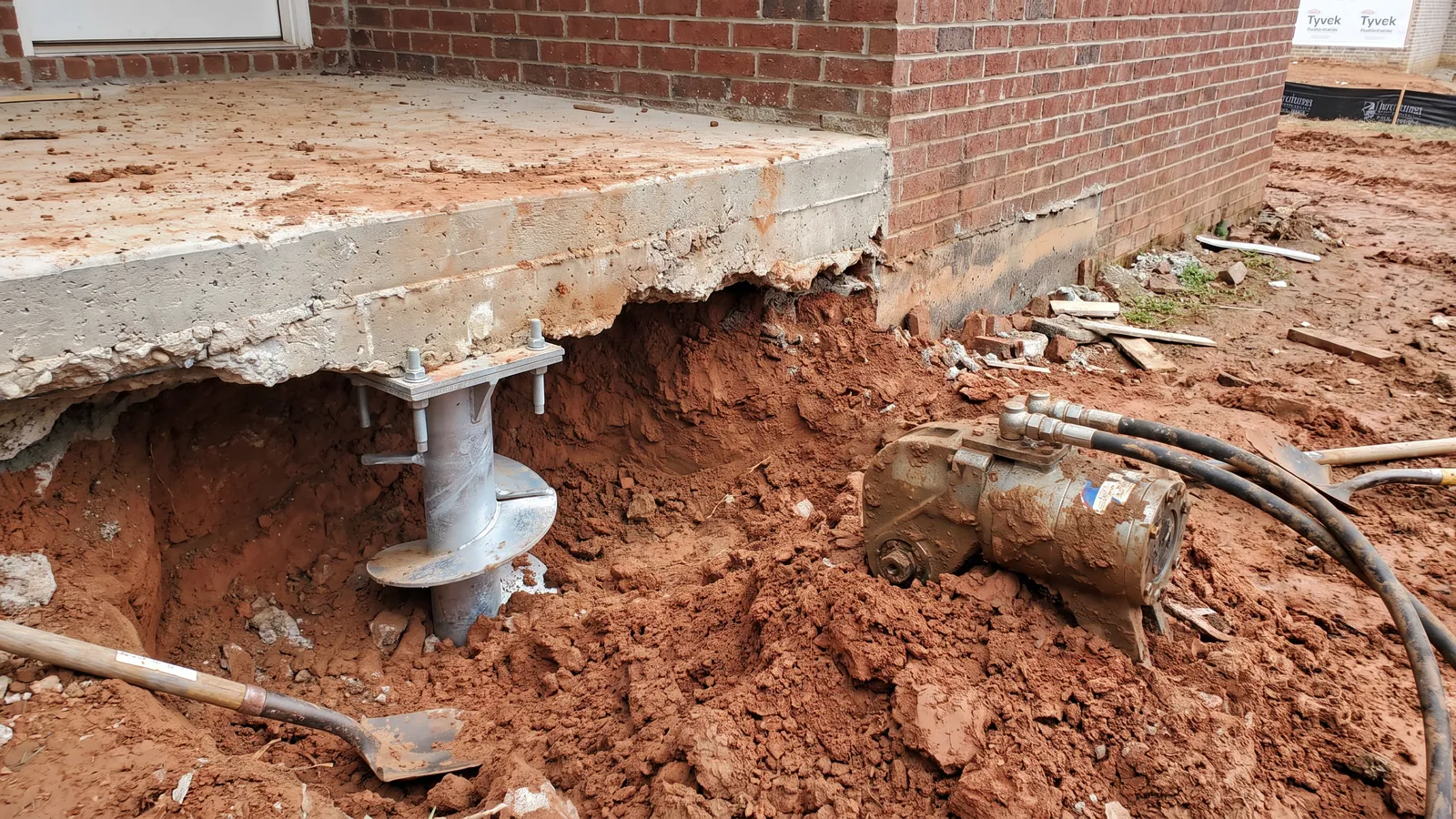
A steel shaft with one or more helix plates welded near the tip, turned into the ground with a hydraulic torque motor like a giant screw. The installer watches torque, not depth; when the reading reaches the target that the engineering tables say will carry the load, the pier is set. A bracket then connects it to the footing.
Suits: lighter loads, crawl-space piers, additions, porches, decks and anywhere the house cannot serve as the reaction; spots where bedrock steps up and down unpredictably, as along the east-side ridges; and new construction. Also the pier of choice when a lift must be done without putting the house's full weight on the system.
Does not suit: very rocky ground where the helix cannot turn, or where a buried boulder stops it short.
2026 cost: $1,400 to $2,500 each installed.
Concrete block and poured concrete piers
The crawl-space standard: a stack of concrete block, or a poured column, on a concrete footing dug a foot or two into the ground, with shims and a cap at the top carrying the beam. They do not reach bedrock; they spread the load over a footing wide enough for the clay to carry. They work as long as the clay under the footing stays reasonably stable and the footing was actually poured, which in a lot of 1950s houses it was not.
Suits: replacing a leaning or crumbled block pier under a crawl-space house on ground that has not been moving much.
Does not suit: a spot where the old pier sank because the clay under it is wet and soft; a new block stack there sinks too.
2026 cost: $600 to $1,400 each. Adjustable steel piers, a threaded steel column on a footing that can be re-shimmed from a wrench, $900 to $1,800.
Pressed concrete pilings
Short concrete cylinders pressed into the ground one on top of another, common in parts of Texas and sold in Alabama by some national companies. They stack to whatever depth the soil allows and depend on skin friction with the clay rather than reaching rock. In Huntsville's clay-over-limestone they can work, but they cannot be driven into the rock, they cannot be torque-verified like a helical, and they are harder to lift against later. Ask why one is being proposed over steel.
Wood posts
Under farmhouses up the 231 corridor and the oldest streets in the city you still find cedar or oak posts sitting on a flat rock, or on nothing. They were fine for eighty years. When they rot at the ground line or the rock tilts, they get replaced with a block or steel pier on a footing; nobody installs new wood.
Side by side
| Type | Reaches rock? | Best for | 2026 cost each |
|---|---|---|---|
| Push pier | Yes | Heavy brick houses on deep clay | $1,300 – $2,400 |
| Helical pier | Yes, or to torque | Lighter loads, crawl spaces, uneven bedrock | $1,400 – $2,500 |
| Block / poured pier | No | Crawl-space pier replacement on stable ground | $600 – $1,400 |
| Adjustable steel pier | No | Crawl spaces that will need re-shimming | $900 – $1,800 |
| Pressed concrete piling | No | Clay without hard rock; ask why | varies |
| Wood post | No | Nothing new; replaced on sight | — |
What the technician weighs
The weight of the house at that footing. The depth to bedrock, from the county's soil maps and from the first pier driven. Access for the equipment. Whether the house can be used as the reaction. And what the warranty will say, since steel piers to bearing carry the longest ones. The findings sheet names the type, the count and the reason.
What people ask about this
Are push piers stronger than helical?
Neither is stronger as a rule; both are sized to the load. Push piers verify themselves by refusing to go further; helicals verify by torque. The choice is about the house's weight and the ground, not strength.
How deep will the piers go under my house?
In the Huntsville valley, often eight to fourteen feet to limestone. Along the ridges, anywhere from four feet to more than twenty, sometimes on the same house. The first pier driven tells the crew what the rest will do.
Do steel piers rust?
They are galvanized or coated and are in clay, not in moving water, so the design life is counted in decades. The warranties the contractors we book offer on them run long for that reason.
Can piers be added later if more of the house settles?
Yes. A footing that was piered on one side can have piers added on another later. That is one argument for a thorough laser survey first, so the whole picture is known before deciding how much to do now.
Why not just pour a bigger footing?
Because the problem is the clay under the footing, not the footing's size. A wider footing on moving clay moves with it. Reaching past the clay is the point of a pier.
Keep reading: Slab foundation repair · Pier and beam repair · The full 2026 price list