The signs a Huntsville house is moving, and the ones that are just August
A house on Madison County clay sends small signals all year: a door that catches in late summer, a hairline over a window, a floor that creaks in a new place. Most are the clay breathing. A few, especially when they arrive together and in the same corner, are the footing telling you it has moved. Here is how to sort them without a tape measure, and then with one.
The signals, from least to most worrying
Doors and windows that stick in late summer
The clay dries and shrinks from July through September, one side of the house drops a hair, and the frame goes slightly out of square. If the same door frees up by December, the house is riding the seasons and you are watching, not calling. If it sticks worse every year, or a crack has opened above the frame, the corner is settling.
Nail pops and drywall cracks at corners
Small round bumps where a drywall nail has pushed out, and short cracks at the corners of door and window openings, are the walls flexing. One or two are life. A row of them along one wall, or cracks that run diagonally from the corners of openings and keep growing, are the wall racking because the floor under it has tilted.
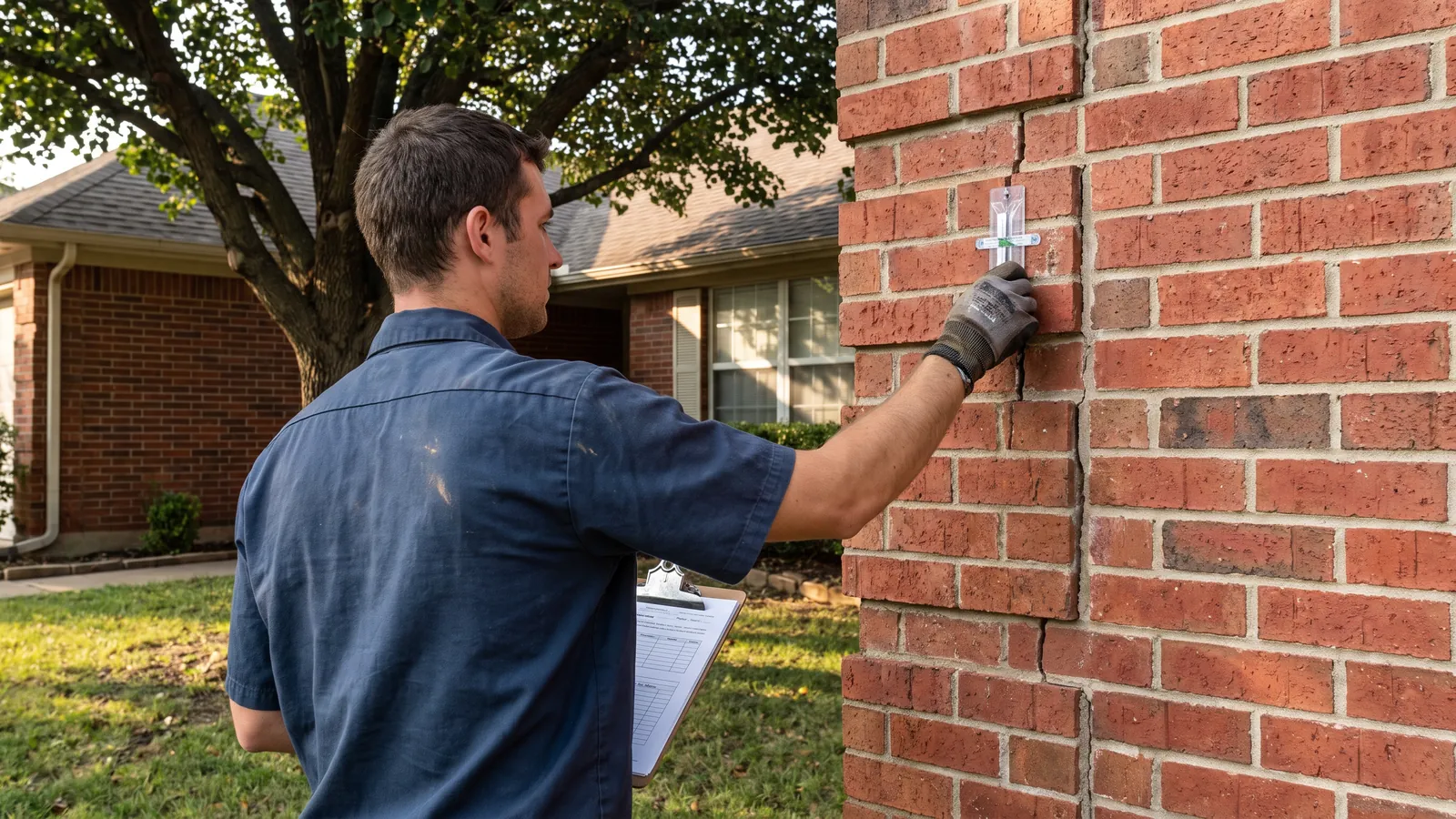
Cracks in the brick
Stair-stepping through the mortar at a corner, or a vertical crack through the bricks themselves, means the veneer is following the footing. Old, hairline and painted over: it happened and stopped. Fresh, wider than a quarter inch, or with a gap at the top: it is still happening.
Gaps
A gap opening between the brick and the window frame, between the carport slab and the driveway, between the chimney and the wall, or between the baseboard and the floor along one wall. Gaps are the house pulling apart at a seam, and the seam is usually next to the part that dropped.
A floor you can feel
A marble rolls toward one corner. A door swings open on its own. The kitchen floor feels like a gentle hill. In a crawl-space house this is a pier or beam problem; in a slab house it is the slab edge settling or the center heaving. Either way it is measurable, and the laser survey measures it.
Water where it was not before
A damp line at the base of a basement wall after rain, a wet patch in the crawl space, a crack in the slab that stays dark. Water is both a symptom and a cause here: it softens the clay that then lets the footing settle, and it is the thing a settling corner lets in.
A horizontal crack or a bow in a basement wall
The one that skips the watching stage. Soil and water on the east side push on the uphill wall, the wall bends inward, a crack opens across it a third of the way up. Hold a string line top to bottom; an inch of bow is a call this week, two inches is a call today.
Reading them together
One signal is a signal. Three in the same corner of the house are a diagnosis. The classic Huntsville pattern: the back left corner of a 1970s brick ranch sits where the downspout empties and the ground slopes toward the house. The door to the patio sticks in August; there is a diagonal crack from the top corner of the patio door; the brick outside has a stair-step crack at that corner; the back bedroom floor slopes toward the outside wall. That corner has settled, the cause is water, and the repair is piers plus a downspout extension. The inspection confirms it with numbers.
What the seasons do
| Season | What the clay does | What you tend to see |
|---|---|---|
| April – May | Swells with the heaviest rain of the year; perched water table at its height | Wet basements, heaving slab centers, doors that bind at the top |
| July – September | Dries and shrinks, fastest at the slab edge and under trees | Settling corners, sticking doors, cracks opening at corners |
| December – February | Freeze-thaw pries at mortar; clay stays wet | Brick cracks widen a hair; crawl-space piers heave on wet clay |
| After a storm | Sudden saturation or erosion; wind loads on the structure | New cracks within days; water in new places |
How to check without calling anyone
- Walk the outside at every corner and look for stair-step cracks and gaps at windows. Photograph each with a coin for scale and the date.
- Inside, open and close every exterior door and note which ones catch, and where on the frame.
- Put a four-foot level on the floor in each room, or a marble on a hard floor, and note which way it goes.
- Look at the basement or crawl space walls for horizontal cracks and the floor for damp.
- Go outside in rain and watch where the downspouts put the water and whether the ground carries it away from the house.
- Do the same walk in three months and compare the photos.
If anything grew, or if step 4 found a horizontal crack, book the inspection. It is free, it takes an hour, and the written findings will tell you whether you have a season or a settlement.
What people ask about this
Is a sticking door always the foundation?
No. Humidity swells wood doors in summer, hinges loosen, houses settle a little in their first years. Sticking that comes and goes with the seasons and has no crack above the frame is usually not the foundation. Sticking that gets worse each year and comes with a crack is.
My house is only five years old. Can it already have foundation problems?
New houses on freshly graded clay settle in their first decade as the fill consolidates. Most of that is minor and stops. A new house with a stair-step crack at a corner and a sloped floor is worth a look, especially if the lot was built up.
How can I tell settling from heaving?
Settling drops an edge or corner, so the floor slopes toward the outside wall and cracks are wider at the top. Heaving lifts the center, so the floor domes, interior doors bind at the top, and cracks are wider at the bottom. Heaving in Huntsville usually means a plumbing leak under the slab or a tree removed nearby.
Should I worry about one crack over one window?
Photograph it, date it, and check it in three months. One diagonal crack over one window is common and often stops. If it grows, or others appear nearby, call.
Do trees cause foundation problems here?
A large oak or hackberry within fifteen feet of a footing pulls a lot of water out of the clay in a dry summer and can settle that side of the house. Removing one can do the opposite and heave it. Both show up in the survey.
Keep reading: Reading cracks · Foundation inspection · Foundation repair in Huntsville